Showing posts with label PR. Show all posts

Friday, September 10, 2010

Blogging More Powerful Than Twitter

By Mike in Tokyo Rogers

I know a lot of people who spend zero time blogging but spend a lot of time on Twitter. Even though I have written many times before about what I think is the poor future of Twitter. I do use Twitter several times everyday. But I do get the impression that Twitter may be setting itself up for a fall.

I think that if you don't blog and just Twitter, and expect to use that for some kind of sales, marketing or promotion, you are kidding yourself. If you don't blog and want to use Twitter just for fun, then that makes sense to me.


I can easily imagine Twitter becoming like Myspace in three years. Does everyone remember when Myspace was the all the rage? I do. I even ran a huge Myspace community page with thousands of  "friends." I haven't touched that Myspace page in over a year. Myspace is a pain.

I'm not the only one who thinks Myspace is dead.

There are several reasons that I think Twitter is heading for uselessness. First, over 60% of all Twitter users quit in the first month. I also get tons of tweets from people nowadays that say, "Want to get thousands of followers on Twitter?" I the click their link and go to their Twitter bio page and see that they have fewer followers than I do. Then, Twitter is down far too often. Follow that with the Twitter censors and manipulates its "Trending" nonsense and you've got a service that, seems to me, is heading for a fall.

The third thing that bothers me about Twitter is that I do know that people are Twittering, but how many are actually reading?

I have written before that, if you are only pushing "Sell! Sell! Sell!" then why would anyone read or even follow you? You must give away great FREE content or no one will bother. I make it a point to give away great free content religiously everyday on my blog....

And that gets me to my point of this particular blog. I have encouraged many people to start blogging. Some do, some don't. The ones who have and have been diligent about it, have reaped rewards and they thank me... The ones who haven't have been taking what I call the "Lazy man's way out" and that was by using Twitter instead of blogging.

Like I said, Twitter is useful, but without a base, without a blog, just writing tweets and directing people to other sites besides your own is not efficient. It's lost productivity.

Well, now, luckily for me, someone has come out with data to support my opinion that Twitter may not be the silver bullet for disseminating information on the Internet that everyone thinks it is.

PR Daily News Feed the newsletter about Public Relations and Marketing in the Age of Social Media writes:


PR’s heavy hitters aren’t embracing Twitter

This one is confounding. Powerful people in PR are, in some cases, absent entirely when it comes to social media. In July, PRWeek released its “Power List” of the industry’s top 25 professionals. Less than half of them have a Twitter account, reports the PR 20/20 Blog. “Of these 12,” writes PR 20/20, “five have never posted a status update; four of those don’t have a photo for their account; three don’t have bios; one protects his tweets; four tweet on occasion, approximately once per week; however, most information shared is self-promotional (personally or for the company).” Clearly the old guard and ways of the older Jedi still persist. Either that or these folks are “too damn busy” for social media. 

Sure Twitter is useful still. But where will it be in three years? The jury is still out. I think that one can easily calculate just how many different people are really sending out Tweets by looking at their Twitter account. Seems to me I keep seeing the same people.... Throw on top of that the 60% who quit after the first month and it makes you wonder about that guy who has 10,000 followers. 10,000 is an impressive number, yes... But have 1/2 those people quit already and never view Twitter?


But with my blog, I know for a fact that 500 ~ 600 or more people are visiting and reading. This is a number that has been increasing by at least 10% a month consistently. They come because they want what I have to offer; Japan and marketing and a place to get creative ideas. And that is, hopefully, interesting and useful content for free. Blogging can't be beat if you want to do sales or marketing.   You can guess that I believe a blog, offering great, free and useful information, updated daily is critical.

Read more about effective blogging daily and better Google rankings here.

Read more about effective blogging for companies here.
-------

Keywords: blog, blogging, Mike Rogers, Twitter, Marketing Japan, Tweets, PR, marketing, Mike in Tokyo Rogers, Myspace, Google

Thursday, July 29, 2010

Does Social Media Need Old Media to be Effective? No! Here's Proof!....

By Mike in Tokyo Rogers

There sure is a lot of boring stuff on Social Media these days. I was just checking out Linkedin where they had a topic of "What are for you the most common mistakes in social media marketing approach?" (sic)

It said:

What are for you most the common mistakes in social media marketing approach?
Either from client's side or agencies' side, what are the obvious reason why social media strategies you have seen were not working?

For me , some are:
- lack of time investment,
- Boring / irrelevant content,
- lack of clear objectives,
- Being inactive,
- Do not react when sollicitate
- ...
What are yours?

(sic)

I didn't correct his post. That's how poorly it was written. I'm assuming that he's missing one of the reasons that his SMM is doing poorly is because his spelling, diction and grammar are wretched... 

Besides that, these good people are mainly talking about pick, Twitter and Facebook (Mixi is only in Japan). Some of the good folks actually did write intelligent comments and I usually don't write comments on these things, but this time I made an exception. I responded:


 I think everyone is missing two huge points that I see all the time and that I do believe will be, say, Twitter's undoing within 3 years (besides 60% of all Twitter users dropping off within the first 30 days).

1) Boring writers make boring content. Get motivated, creative and funny or interesting writers. Quit forcing office clerks to do SMM (I see that all the time). If the writer is not motivated what makes anyone think the readers will enjoy the writing?

2) Quit sending out motivational and sales stuff all the time... I'd say that at least 1/2 of the junk I get on Twitter is the same as Direct Mail. Who needs it?


Another guy (obviously an old hand at advertising and marketing) wrote:


I see the market and clients every day, and the thing I can tell you is that a B to C company investing all its marketing budget and ressources in social media has 99% chances failing. (sic)


This might be true, but rather than trying to convince you or me, I gather he is trying to convince himself... This would also explain why his Social Media Marketing efforts fail. He doesn't "get it." 


He goes on to write:


This for one simple reason, their are rules and processes in marketing and nobody will want to connect and engage with a brand you don't know.
For this reason , I am convinced that SM works ONLY when being integrated inside a marketing plan, together with media placement, PR, promo, direct marketing and CRM. 
(sic)


Notice that there is not single fact or piece of evidence that he inserts into his claims. What a load of nonsense. What "rules"? What "processes"? 


(I can imagine that his retort to my skepticism would be "Because I know. I've been in this business a long time!" Just as the captain of the Titanic, Edward Smith, was a thirty-two year veteran when they hit that ice-berg!)


I bet this is the kind of crap he tells his clients. What's he doing on a Linkedin Social Media site besides posing as a SMM expert I don't know. Besides that, like I said, I hope this guy doesn't write copy. It's terrible. 


Besides his being wrong and just throwing out opinions. He obviously doesn't know or comprehend how to use Social Media well... I suspect that, from being in a dusty old advertising company desk for so long, that he's so used to taking client money and going out to "do" lunch while on the client's dollar that he thinks he can do things the old way; think for a while (or tell someone else to do the thinking) and order someone else to do the Social Media part (I explained above why that's a bad idea) and sit around like always.


Meet the new boss, same as the old boss. 


I didn't blast the guy (like he deserved), but added this as my last word:


One more thing that I think is missing - and I don't agree that a big bucks mass media plan is necessary - I've done it without one.

Notes: We increased airline passengers to and from Japan for a Chinese airlines by over 270% between October 2009 and April 2010. We also increased tourism to Croatia by 300% in three years (don't forget this was during a seriously down market - airlines lost billions in 2009) all by the internet only - with minimal mass media support (we certainly did not spend one cent on mass media!).

It seems that too many good folks are trying to do the SMM the lazy way... You do SMM to keep costs down, but SMM is, perhaps not labor intensive, but it is certainly effort intensive.

Besides SMM you need to do a Word-press blog for the client that includes SNS (Use Ruby on Rails to build - dirt cheap) and gives away killer content, has contests and prizes, and motivates people to return everyday!

Being lazy and throwing money away at the old media then doing a few Twitters doesn't cut it anymore. (which is actually why I say Twitter is in serious trouble!)

Make a killer blog for the client (perhaps using a persona like Helga of Volkswagen - Look her up on Google). The blogs needs video (suggest U-Stream recorded to YouTube), SNS, chat, free information, excellent and compelling writing, and free giveaways all the time.

That motivates people!

Then your SMM directs people to the blog, not to some boring corporate site that is nothing more than an online company brochure (that is structured like web 1.0) .

This is effective. This s the new way. It is not easy and lazy people who think that throwing money or half-butt efforts at it need not apply.


Like I've said many times before, it seems that a lot of these people who claim to be experts at Social Media actually do not "do" Social Media. If you ever get anyone who claims to be an expert, first off ask for their URL's


Hint: If they do not blog - and do not actively blog at least three times a week - I'd say it's a 99% chance that they are blowing smoke in your face. Don't fall for it. 


Smart Social media marketers will have a rundown of what they do (excepting for invitation members only sites) as the signature of their e-mails. Here's mine:


Mike in Tokyo Rogers
e-mail: mike.rogers@universal-vision.jp 
Blog: http://modernmarketingjapan.blogspot.com/


Look for these kinds of things when investigating a potential company to help you with marketing. Be leery of companies, big or small, who claim to be experts at Social Media. The proof, as they say, is in the pudding.


Some of my readers know I will be on vacation from tomorrow, but nevertheless the BLOG calls! Tomorrow, I will place diagrams and information tomorrow morning for all of you who have mailed about bit differentiations between Japanese Katakana and Japanese Kanji versus English pertaining to my recent blog.


But, just for a teaser. Consider:


Word (translation).......................................Bit count


イギリス (England)...................................8 bits
England.......................................................7 bits
旅行 (Travel)...............................................4 bits
Travel...........................................................6 bits


Data on the Internet consist of bits. It is the way data is stored. This is important to know if you want to run a successful business in Japan.


------------


Keywords:
blog, Social Media, Mixi, Google, Helga, SMM, Mike Rogers, Social Media Services, China, Croatia, England, Travel, bit, bit count, Japan,  Japanese Kanji, Modern Marketing Japan, social media marketing, promo, Japanese Katakana, PR, Twitter, marketing plan, Facebook, Linkedin, airlines, YouTube, U-Stream, e-mail, Lew Rockwell, Mike in Tokyo Rogers, chat, Marketing Japan, web, web 1.0, Volkswagen, Ruby on Rails, Placement, Word Press, mass media, free information, direct marketing,


Saturday, July 3, 2010

Marketing Japan: A Primer on the Long Tail

By Mike in Tokyo Rogers

What is the Long Tail?

The Long Tail is transforming our lives and our businesses. If you are considering ways to improve your business and your life, then you do need to understand what the Long Tail is and its ramifications.

Anyone who wishes to do any business utilizing the Internet or any Social Media needs to fully understand the Long Tail in order to improve on whatever it is they are doing. That includes Facebook, U-Stream, blogs, Mixi, blogging, video-blogging, Myspace, vlogs, Pick, Linkedin or Twitter.

Average Japanese TV station upper management business model

In fact, if you are involved in any of the above, then you are a part of the Long Tail.

Recently, my partner and I went to a satellite TV station here in Tokyo, Japan that is not doing too well... In fact, they are all worried about their future and the future of their station. (Incredibly, there are old media people who seem not to be worried about their station's - and their future - but this blog is for people who are not brain-dead.) Over these last 5 - 10 years, advertisers have been abandoning satellite TV (as they have been abandoning all other Mass Media formats) and spending their marketing and advertising yen in different areas.

Not only have advertisers been abandoning them, but, even more alarming for them is that the viewers have been getting off the sofa and doing other things too. Subscription Music TV is no longer cool like it used to be. And why should it be? Why do I have to sit through ten crappy videos to maybe see one I like when I can go on YouTube or Myspace and see what I like immediately? (Both YouTube and Myspace are excellent examples of the Long Tail in practice).

Don't be confused, just because this particular station is a digital satellite station, don't think they are not in trouble; they are... Admittedly, though, they are in much better shape than a dinosaur such as TV Tokyo or TBS is, but that is only because they do not have over a thousand employees like those terrestrial stations do. Most of these satellite stations in Japan have anywhere between 40 - 80 employees so their books - and their chances of survival - are much better than the major terrestrial TV stations.

Nevertheless, even though they are a satellite TV station, their business philosophy is still strongly rooted in analogue type of thought; and this will be their downfall if they don't act soon.

The station in question has been struggling through a few years of trying to figure out how to utilize the Internet to help survive as a broadcasting station but they have come up short consistently every time... I think the problem lies in that they can't get their heads around the fact that they will have to stop thinking like a TV station and start thinking like an Internet business in order to survive.

After having several meetings with them, I think I've figured out what their basic fundamental problems are: they do not understand the Internet (they think it is a crutch to support their TV broadcasting and they haven't a clue as to what the Long Tail is and what it means to them.

Up until now, and for the foreseeable future, broadcasters in Japan are, and will be, stuck in old-fashioned thinking. They still use their web pages as a place for one-way communication to their viewers. Simply put, their web pages are boring and, frankly speaking, only serve as an online TV Guide listing for the program schedules.

Not exactly the kind of content that is going to start a buzz or an overnight Internet sensation.

They also do not understand how the web can be an avenue for creating new business and money streams... It is my guess that this particular station probably loses about ¥200,000 ~ ¥500,000 yen (about $2,000 ~ $5,000 (USD) per month on their web page when they could be - should be - making money from their web site, like so many others do.

Of course, we had been trying to explain to them about the concept of Web 2.0 and creating "community" by giving away free, interesting content online, but for some reason, they never seemed to quite "get it." Oh, they seemed to understand that something has to be done, but couldn't put their finger on what exactly that it is that has to be done.

I gather that after our meetings they would go back to their company meetings and say things to their compatriots like "Yeah! Mike says we have to do Social Media and Social Marketing! He says we have to be more intelligent about our online business and in creating community! He says we have to put content online and giveaway content free..."

Then the boss would retort, "Why?" and then that's where the confusion came in... I'm sure the room would grow quiet.

But finally, at this last meeting, I think I have gotten through to them as to why they need to act. Finally, I believe that I explained it in a way that makes sense to them. And that explanation was the Long Tail. (Please understand that I am a professional speaker so if I had trouble explaining this to these good folks, I can imagine how hard it must be for most!)

So, now let me give you an EXTREMELY short explanation of what the Long Tail is. I also have a link below to Chris Anderson's bible on the subject, "The Long Tail" that I strongly recommend!

Highly recommended: Chris Anderson, The Long Tail 

The Long Tail explains is how things have changed in these last 10 years or so.

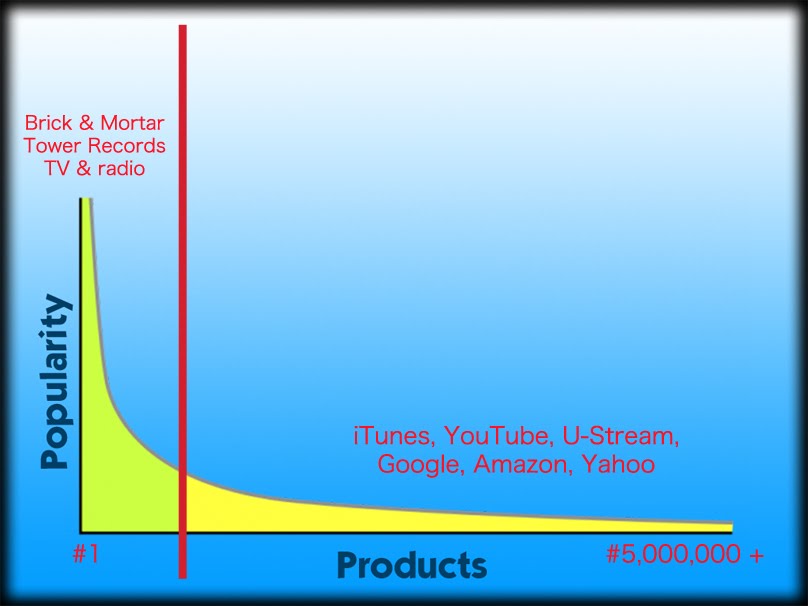
At the head of the tail (the top), there are your standard Brick and Mortar shops and businesses; shops that have limited retail space. In my example, I'd like to use Tower Records.

Tower Records is probably the most famous of the old style record stores. Everyone knows them... I used to go there  lot. Unfortunately, I figure they have a very bad future and won't be around in 10 years. In spite of having a huge amount of floor space, Tower cannot possibly carry everything.

Tower takes a risk on ordering product and having to distribute that product to their various stores. They have to guess how many of each product each store can profitably sell. It is inevitable that they will guess wrong.

For example, the new NOFX record comes out and a kid wants to buy it in the Tower Records Shinjuku store, but the Shinjuku store is just sold out - while the Tower Records Shibuya store still has 5 copies. What happens to the kid at the Shinjuku Tower Records store? He goes to another record shop nearby, in Shinjuku, and buys what he wants... Tower Records loses a sale.

For companies like iTunes, or Amazon, who work on the Long Tail, this is a huge advantage for them over the traditional retailers; they have no shelf space (well Amazon does too - to a degree - but they started MP3 and download business too).

A key component to understanding the Long Tail is shelf space. Businesses and organizations that cannot capitalize on the Long Tail have space restrictions. For each centimeter of shelf space, Tower Records must make a certain amount of money in return. In this case, Tower Records cannot possibly have enough shelf space to have everything, floor space costs money. So, Tower Records can only sell the hits or any CD that they might reasonably expect to sell more than ten or twenty (or, preferably, several hundred).

Philosophically, it is obvious that when one tries to be friends with everyone, they are friends with no one. This is why I predict that, say, InterFM will go bankrupt by end of 2012, maybe sooner. I also predict TV Tokyo insolvency by end of 2014.

But back to the Long Tail.

Tower Records, TV and radio stations have only so much "shelf space" they are confined to a physical world. But, take iTunes for example; iTunes has no space restrictions. iTunes carries millions of titles and their catalogue grows daily. How many titles does the biggest record store in the world carry? 30,000? 100,000? And each of those titles cost money to carry; they must pay the rent. Shelf space costs money!

How much does it cost iTunes to carry some bits on a server that has 3 million titles on it? Almost nothing and it's getting cheaper by the day.

Look at the chart below. At the left are my examples above: Tower Records and the TV and radio stations. They only have so much space, space costs money; they have to cut off somewhere what product they are going to carry or broadcast. THAT is the point where the Long Tail begins.


I have marked the cutoff line in Red. To the right of that red line (and, by the way, including everything to the left of that cutoff line) are the products that a company like iTunes carries.

You'd think that, to the right, this line eventually goes to zero. It doesn't. It never goes to zero. The market is growing exponentially (in spite of what the major labels are saying) and because people are being offered more and more choice, they are taking it. Today we are witnessing a cultural explosion of DIY people and new artist's, authors, publishers, musicians, comedians, producers, writers and more. The end is not anywhere in sight.

The Long Tail is providing us with much more freedom of choice.

And here is the kicker, because storage of data on bits costs nothing, then places like iTunes, Amazon (MP3, E-Books), etc. can store hundred's of thousands, no millions of titles... More, if they wish... And it costs them almost nothing. It will be Game Over once the rights issues are resolved.

Now, look at the chart above again.

To the left are the old stores and old media. At the bottom is the Long Tail of the new media. It is a fact now, since people are being offered so much more choice, that "Apple said that every one of the then one million tracks in iTunes had sold at least once (now the inventory is twice that)." This means that, cumulatively, that the products in the Long Tail add up to a significant portion of iTunes business... As the tail gets longer, it is merely a question of time (probably a relatively short period of time) when the Long Tail's total sales will surpass those at the head of a traditional retailer.

What will that mean for our culture, entertainment and economy?

Even with this explanation, I knew, from experience, that I still had to educate my friend's at the satellite TV station to be able to go to their boss and explain to him why we had to reform their Internet business....

I did that. Now, if you need any more convincing, take my chart and turn it vertical. Now the end of the Long Tail is at top and it is still extending.

Where does your business want to be in the next few years? 
At the right or on the bottom?

And the bottom, well, the popularity segment is shrinking as can be witnessed by dropping sales of major artists and Rock radio...

Now, where do you and your business want to be in the next few years? At the top right or at the bottom?

Utilize the benefits of the Internet to, not only benefit your current business, but to reform and revitalize it. Understanding the Long Tail is key. Now that's not just smart, it's good business and intelligent marketing.

Note: For a more detailed explanation of the Long Tail, I highly recommend reading Chris Anderson's "Why The Future of Business is Selling Less of More - The Long Tail"

-------

Keywords:
Internet, Marketing Japan, Subscription Music, E-Books, Myspace, Tower Records, entertainment, Apple, video-blogging, Mike Rogers, Subscription Music TV, Japan, blogs, Tokyo, satellite TV station, Shibuya, economy, Chris Anderson, NOFX, marketing, Pick, Amazon, U-Stream, TV Tokyo, marketing, InterFM, Linkedin, entertainment, PR, Terrestrial TV, blogging, Social Media, Modern Marketing Japan, advertising, Long Tail, Mixi, Facebook, vlogs, Mike in Tokyo Rogers, FM stations, Twitter, Shinjuku, Youtube, iTunes, culture, TBS, The Long Tail, DIY,

Tuesday, June 22, 2010

Woman From Ventura Hooks Monster Fish

By Mike in Tokyo Rogers
Yes, yes, I know. This blog is about PR, advertising and (viral) marketing in Japan using new Social Media like Twitter, Facebook, Mixi, blogs, vlogs, and Pick...

But, for your momentary pleasure, let me indulge myself (and hopefully you too) into a momentary escape from the hustle and bustle of today's fast paced life to give you a short break.

Look at this! A woman from my hometown of Ventura California hooked and landed a 380 pound (172 kilogram) halibut! Look at the size of this fish!!!


Wow! What a fish. Seriously though, I wonder how many years it takes a fish to get to be this size? I think, and I'm not joking, that I must have hooked one if its brothers or sisters way back when I was fishing in Pt. Hueneme near Ventura back in the early 80's.

I hooked this massive halibut then and almost had him reeled in when he broke my line. We could see the halibut right by the shore and it was at least a meter and a half long (about 4 or 5 feet)...

But, of course, I lost it.

Congrats to this fine fisherwoman and thanks for the wonderful break.

Now, get back to work!   

-----

Keywords: Halibut, Ventura, Mixi, PR, 172 kilogram halibut, advertising, Twitter, monster fish, viral marketing, Facebook, marketing, Social Media, vlogs, Pick, blogs, fish, fish story, 380 pound fish,

Marketing Japan: Online Newspaper in Japan Bites the Dust....

By Mike in Tokyo Rogers

JanJan, an online newspaper here in Japan, has folded their Internet operations. Janjan was to be the digital answer to Japan's old guard press. The story of the Internet company folding got so much traction that even the business section of the New York Times wrote about it today! The article talks much about what Janjan tried to accomplish, but I think it misses the point and doesn't seem to want to talk about how print media and newspapers are losing out to the Internet when it comes to everything including information, smart marketing, PR and advertising - or any PR for that matter - here in Japan.

I tried to find a more modern picture of a guy reading the newspaper...

Oh well, the article did appear in the New York Times who, of course, wants to conveniently forget that, Internet company or otherwise, would have a hard time competing in a staid market like the news in Japan that targets the over 40-years-old crowd for news and marketing.

Let's face it, many young people in Japan couldn't care less about the news - mass media delivered or not; the older people who do care want reputation in their news and will stick with Nikkei Shimbun, Sankei Shimbun, or Yomiuri, thank you very much.

When it comes to TV news, even huge companies like TV Asahi or Fuji TV cannot unseat NHK for viewership or reputation amongst older Japanese.

If the playing field is "the news" (an area that targets over 40 crowd - who still want their newspapers) then there is no way that an online news service could ever hope to unseat the old school. The under 40 crowd in Japan, like anywhere else in the world, that has electricity, do not subscribe to newspapers.

When the service targets under 40 year old people in Japan then print media is basically dying a quick death in this country.

Anyway, I thought the New York Times article was "interesting" and had the usual suspects of "err" that I've come to expect from dinosaurs like the New York Times. In one sentence they claim that the Yomiuri Shimbun has more than 10 million subscribers (I heard from a former top executive at Yomiuri Shimbun that it was only 8 million):

For a variety of reasons, cultural as well as economic, the digital revolution has yet to wreak the same havoc on the news media here that it has in the United States and most other advanced countries. The media landscape is still dominated by the same handful of behemoths that have held sway for decades, like the Yomiuri Shimbun, the world’s largest newspaper, with daily circulation of more than 10 million.


Never, but never, believe these types of sales or circulation numbers when they are touted by any industry in Japan; especially newspapers (add to that magazines, record company sales, etc.) Also, quite hilariously, a few sentences later, the New York Times writes that the Asahi Shimbun claims a 3% drop in subscribers over these last ten years. 


Circulation of The Asahi Shimbun, for example, Japan’s and the world’s second largest daily, has fallen by 3 percent over the past decade to just over eight million.
Well, 3%? That doesn't sound so bad... Hello? New York Times, you conveniently forget to mention what really matters in this equation: Not subscriptions, but revenue! From 1997 to 2006, newspaper revenues have dropped 25%. Read here: http://search.japantimes.co.jp/cgi-bin/nn20090303i1.html

What planet are these New York Times people living on?  Oh, well, forgive the New York Times for failing to state the obvious because the implications for themselves are pretty much doom and gloom... 
In Japan some newspapers still have credibility because they will take the government to task for lying and being incompetent; while in the USA, newspapers like the New York Times, are mouthpieces for the government and, as such, have seen their readership seriously decline because they lie all the time (remember WMD in Iraq? etc., etc.,) and people have lost respect for them... 
For all Japan's warts, we still have a press that is skeptical of the government's motivations and I'm sure that has helped the newspapers to retain readers.... Their revenues? Well, that's another story.
New York Times, why do people need newspapers like you if you are not going to do investigative journalism and just be a voice for the regime? Us bloggers? We have Twitter, Pick, Facebook, Mixi in Japan, and a host of other Social Media to get the word out.

Many older people in Japan still have the habit of buying newspapers. Old habits die hard. But, some of us oldsters are easy to change; especially if money is any motivator. I, for one, certainly don't need to pay a dollar fifty for yesterday's news. I got my old-style traditional blog and my blogger friend's.... Thank you very much.

Here's an old joke for the New York Times:

Question: What's white and black and red all over?
NY Times staff answer: A newspaper!
My retort: No, the New York Times balance sheet!


Anyhow, check out the full article here:
http://www.nytimes.com/2010/06/21/world/asia/21japan.html


------
Keywords: Mixi, Twitter, New York Times, PR, mass media, NHK, advertising, newspapers, Asahi Shimbun, Japan, business Internet, marketing, Yomiuri, TV, targeted message, Nikkei Shimbun, traditional blog, goods, Janjan, services, TV Asahi, Sankei Shimbun, advertising, Pick, blogger, traditional media, blogmessage, newspaper, Facebook, product, online advertising, Social Media, Fuji TV, Marketing Japan, intelligent, New York Times,  

Friday, May 14, 2010

How New Companies Can Succeed in Japan - And How They Fail


Many new companies, especially in IT, think that to make it in Japan, all they need to do is release a Japanese language version of their product... They couldn't be further from the truth. Japan is an entirely different animal.

To succeed in Japan, of course a company needs a Japanese version of their product, but just that won't do the trick. They'll need experienced, well-connected PR and Marketing in Japan. 

On top of that, the new company product/service will probably only have one chance to do their initial product/service release right in the Japanese market. Their first release is their Golden Chance in Japan.... It could also be their only chance in Japan. 

If a company blows their initial release of the product/service in this country, the company will most probably not succeed here. Ever. No matter how much money is spent on PR and advertising. Many before who have made this mistake have tried to recover and failed; even ones with multi-million dollar budgets. A good case in point is Pepsi Cola. Pepsi spent tens of millions of dollars and twenty years for terrible results.


Now, they've finally gotten smart and tied up with a Japanese beverage maker so their prospects are better... Why didn't they do that from the start? Disney, Coca-Cola, McDonald's, and many others did. Why did Pepsi even bother to try to reinvent the wheel?

How to correctly handle a new product or service release?

A new company/product/service will need to appoint somebody in Japan to handle PR for them in Japan and work with that company to make a plan. 

A necessary part of any good plan of attack would be that the representatives in Japan arrange meetings with major media at least 1 - 2 weeks before Japanese release day, as pre-press release. This is critical.

If this sort of ground-work is not fully prepared by the company and their reps in Japan, I strongly suggest that the company postpone the release of the product/service (and fire their  representatives and hire a competent company) and then get properly prepared. If this sort of pre-press release is done correctly, the Japanese media will then follow-up and prepare and study the circumstances of the product/service and company so that they may be able to publish and provide better information for the Japanese audience (don't forget that the Japanese media are competing with each other, too, to provide up-to-date concise information, so this has to be done. No short-cuts here). This is critical for the success of any new company in Japan.  

Even after years of repeated failures by various companies, to this very day, foreign companies come to Japan and repeat the mistakes Pepsi Cola and Seven-Up made decades ago. Some recent examples are Linkedin; E-Bay Japan, Google.jp, and a few others. (I strongly suspect Sugarsync is about to make the same mistake too!)

Take, for example, Linked-in. Linked-in came out with a Japanese version quite a while back but no one here in Japan uses it because no one knows about it; they had no local representation; no pre-press release information. 

Kind of shocking, when you think about it; a supposedly forward thinking company coming to Japan and making such an amateurish mistake. 


E-bay is another example of a successful service in the west which came to Japan and flopped because of not having experienced people on the ground in Japan. Neither Linked-in nor E-bay Japan will probably ever recover... 


No, not probably... There's no way they will ever recover here.

Sad. Had they thought about what they were doing and not tripped over the half-dollar in order to pick up the penny, they probably could have partnered with a huge Japanese company and been worth hundreds of millions of dollars in Japan alone by now. 


The situation today? I only know of one other person besides me who even knows that Linked-in has a Japanese version. People know what E-bay is, but prefer Yahoo Auctions by a laughable margin. 


Oh dear! Linked-in and E-bay blew it... and in the second largest market in the world. I wonder how this will affect their stock price? 

Why won't they recover? Well, because they already launched and flopped... They are not newsworthy, except as failures. If the Japanese want to read about failures, they'll read about their politicians. 

An example of a successful Japan launch recently was Evernote. The PR company which handles that was able to get Evernote into Sony so that Sony scanners come pre-installed with Evernote. 

A Japanese language release might have some sort of plan like this:

1) Setting the Key Concept for Japanese Market 
2) Arranging Press Releases for TV, Internet, Papers and Magazines promoting the URL and product/service
3) Press conference for Japanese Market 
4) Make a presentation to major Japanese companies in order to obtain a major Japanese corporation as partner for the Japan market

In Conclusion

Japan is the #2 market in the world... Being lazy and trying to break into this market without understanding the underlying differences between the Japanese psyche and the west is a sure fire recipe for failure.

Pepsi, along with many others, failed... And they spent tens of millions of dollars... Don't repeat these mistakes. Why not make a little effort and find the people who can help you? You do need Japanese representation here on the ground, in Japan, to make your product/service a success.


Remember that success is 80% preparation.

Many others have already shown you how to fail... Here is written the best way to succeed... Will you learn the lesson?


------


Keywords: IT, pepsi, failed, Evernote, Press conference, press release, Sony, Linked-in, Sugarsync, PR, Marketing, Disney, Coca-Cola, McDonald's 
 
Design by emfaruq. All Rights Reserved.